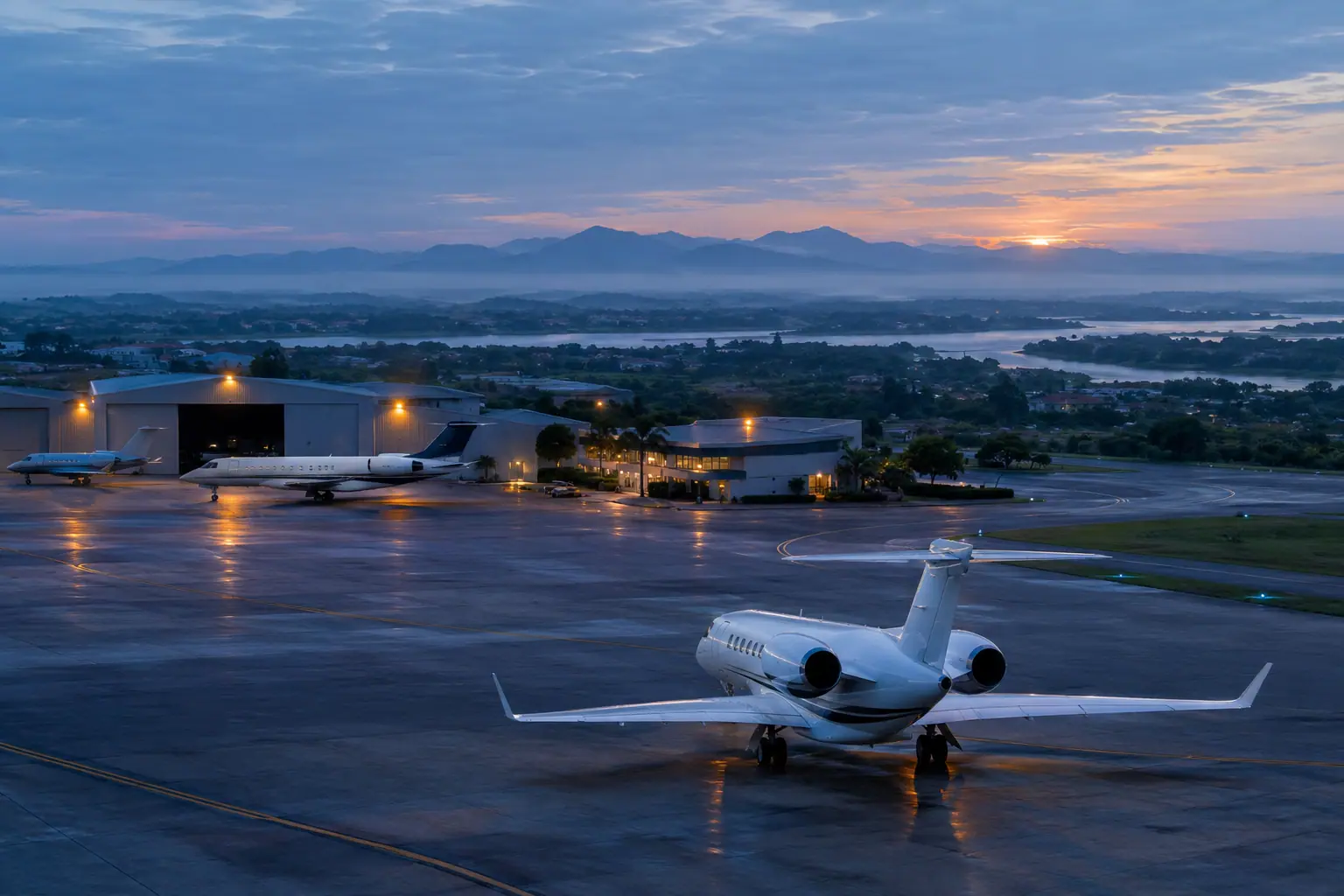
One way private jet Teterboro
A one way private jet Teterboro departure skips the airline terminal. KTEB sits nine feet above sea level with a 6,997 foot runway. This guide covers runways, FBOs, summer heat and westbound legs.
A one way private jet Teterboro request starts with the airport itself: KTEB has one 6,997 foot runway, sits nine feet above sea level, and fields four FBOs, Jet Aviation, Signature Aviation East, Atlantic Aviation and Signature Aviation West. KTEB serves as the New York area's business aviation gateway with four FBOs on one 6,997 foot runway. Because the field handles constant one-way traffic, repositioning aircraft are common. Ask your broker to quote both a dedicated one-way charter and any matching empty leg flights before you commit.
The pattern matters. Operators who fly passengers into Teterboro often need to move the aircraft out again, so a westbound or southbound departure on a Monday can price better than the same leg on a Friday. A one way private jet Teterboro departure to Van Nuys covers 2,227 miles, a distance that usually calls for a midsize or super midsize cabin rather than a light jet. That single number shapes most quotes you will see.
Broker versus operator is the other piece. Under DOT Part 295, a charter broker acts as your agent in arranging the flight, and the flight itself is flown by an operator holding FAA Part 135 authority and operational control. We arrange; we do not own aircraft. Knowing whether your quote comes from a broker or an operator helps you compare the same aircraft and crew fairly. That distinction is worth understanding when you weigh a one-way price, since the difference is in the service layer around the flight.
Teterboro runway and summer limits
Teterboro's single runway measures 6,997 feet, which is generous for a field nine feet above sea level but tight in July heat. The field's density altitude reaches 2,300 feet at 115F, against 1,700 feet in a typical July, and that gap changes takeoff and climb performance for turboprops and light jets. If your departure falls in the hot afternoon window, then an operator may cap fuel or payload to stay within performance limits, so build flexibility into the plan rather than assuming a full cabin and full tanks.
| Runway | Len | Wid | Surface |
|---|---|---|---|
| 1/19 | 6,997 ft | 150 ft | Asphalt |
| 6/24 | 6,014 ft | 150 ft | Asphalt |
Teterboro FBOs and car access
Four FBOs serve the field: Jet Aviation, Signature Aviation East, Atlantic Aviation and Signature Aviation West. Each has its own ramp entrance, lobby and vehicle access, so confirm which one your operator uses before you give a driver an address. Arriving 15 minutes early at the correct Teterboro FBO avoids a cross-field drive with your bags, and it matters more when two flights depart around the same hour.
For international legs, CBP clearance is arranged around the FBO your operator selects rather than the airport as a whole. If you are flying to the Caribbean or Canada, then ask who handles customs and where the aircraft parks on return. Domestic passengers skip that step entirely and walk from car to cabin.
When a one-way Teterboro charter fits
- One-way repositioning legs west to Van Nuys, a 2,227 mile run suited to midsize cabins
- Thursday and Friday departures to South Florida, with Miami-Opa Locka 2,170 miles out
- Business travelers who need the FBO lobby rather than a commercial terminal
- Transatlantic and Caribbean departures where CBP clearance is arranged in advance
| Class | Usual runway req | Here |
|---|---|---|
| Turboprop | 3,300 ft+ | Accepted |
| Light jet | 4,000 ft+ | Accepted |
| Midsize jet | 5,000 ft+ | Accepted |
| Super-midsize jet | 5,200 ft+ | Accepted |
| Heavy jet | 5,600 ft+ | Accepted |
Weather and density altitude by season
January highs average 40F with a density altitude near -1,300 feet, while July highs reach 85F and density altitude climbs to 1,700 feet. Those figures come from the field's monthly averages, not a forecast, and they explain why winter departures often see better performance than summer ones. A cold January morning at Teterboro gives a light jet noticeably better climb than a July afternoon, which can matter on a long first leg.
Wet days run from nine to thirteen per month across the year, with July the wettest at 13 and January, October and November the driest at nine. If you are traveling in a summer thunderstorm pattern, then an early morning slot is the more reliable bet, and a broker who watches the radar can move you ahead of a ground stop. Peak density altitude at 115F reaches 2,300 feet, so the hottest afternoons are the ones to plan around.
| Month | Avg high | Wet days | Density altitude |
|---|---|---|---|
| Jan | 40°F | 9 | -1,300 ft |
| Feb | 43°F | 11 | -1,100 ft |
| Mar | 49°F | 10 | -700 ft |
| Apr | 60°F | 12 | 100 ft |
| May | 70°F | 11 | 700 ft |
| Jun | 79°F | 11 | 1,300 ft |
| Jul | 85°F | 13 | 1,700 ft |
| Aug | 83°F | 12 | 1,600 ft |
| Sep | 77°F | 10 | 1,200 ft |
| Oct | 66°F | 9 | 500 ft |
| Nov | 54°F | 9 | -300 ft |
| Dec | 45°F | 11 | -900 ft |
Getting to Teterboro and onward
Teterboro sits in Bergen County, New Jersey, minutes from the George Washington Bridge and the approach roads that feed Manhattan. A Teterboro departure reaches midtown Manhattan quickly by car outside rush hour, though the Lincoln Tunnel and Route 4 can undo that advantage at peak times. If your schedule puts you on the road between 7 and 9 a.m., then add buffer for the bridge approach. Build the drive into your timeline rather than treating the airport as a fixed point.
Private jet routes via Teterboro
These 6 private jet routes span 199 to 2,129 nautical miles, with one-way light jet estimates from $4,000 to $36,000.



Questions about this airport
How far is a one way private jet Teterboro flight to Van Nuys?
The trip covers 2,227 miles from KTEB to KVNY, which puts it in midsize and super midsize territory. Van Nuys has an 8,001 foot runway and a July density altitude of 3,200 feet, higher than Teterboro's, so westbound arrivals in summer see different performance than the departure. Expect the quote to reflect the longer leg and any repositioning on either end.
How long is the runway at Teterboro Airport?
Teterboro's longest runway is 6,997 feet, at an elevation of nine feet. That length handles most business jets comfortably in cool weather. In July, when density altitude averages 1,700 feet and can reach 2,300 feet at 115F, an operator may limit weight on the hottest departures. Ask about performance limits if you are flying a full cabin on a long first leg.
Which FBOs operate at Teterboro?
Four FBOs serve KTEB: Jet Aviation, Signature Aviation East, Atlantic Aviation and Signature Aviation West. Each has a separate entrance and lobby, so confirm the one your operator uses before you send a car. If you are on an international leg, then ask which FBO handles CBP clearance so the arrival and return both line up.
When is density altitude highest at Teterboro?
July is the peak, averaging 1,700 feet and reaching 2,300 feet at 115F, with August close behind at 1,600 feet. January runs the other way at roughly -1,300 feet. If your trip falls in the summer, then a morning departure usually gives better performance than an afternoon one, and it also dodges the thunderstorm window that brings 13 wet days in July.
How does a one way charter differ from a round trip at Teterboro?
A one-way charter prices a single leg, and at a busy field like Teterboro that can mean an operator already needs to move the aircraft your direction. Empty leg flights are the clearest example, though availability is unpredictable. A round trip keeps the same aircraft and crew waiting for you, which costs more but removes repositioning risk from the equation. Compare both before deciding.
How far ahead should I book a one-way jet from Teterboro?
For a 2,227 mile leg to Van Nuys, a week or more gives the best aircraft choice, and holiday weeks need longer. Short-notice requests are possible because Teterboro sees constant one-way traffic. If your dates are fixed and the cabin needs are specific, then start early enough that your broker can place the trip with an operator holding FAA Part 135 authority and the right aircraft.